Nicolò Cantoni & Demetrios Paraschos
Summer has come and gone, and year two of VERITRACE is officially underway. The past months have been brimming with vibrant activities for our team, and we’re now gearing up for even more exciting work, with the promise of rewarding outcomes on the horizon. Before diving into what lies ahead in future blog posts, we would like to take a moment to share some of the highlights from recent months. We’re starting with a look back at two major conferences: Scientiae in Brussels last June and the European Society for the History of Science (ESHS) meeting in Barcelona in September.
From June 11-14, we had the pleasure of attending and co-organizing the 11th Scientiae conference, hosted at the Royal Flemish Academy of Belgium for Science and the Arts in Brussels. This four-day event was filled with engaging presentations, including two standout keynote lectures by Prof. Dr. Steven Vanden Broecke and Dr. Sietske Fransen. Scientiae 2024 was especially meaningful for us. Not only did VERITRACE help support the conference (in collaboration with the FWO/FRS-FNRS-funded RENEW18 project led by Prof. Dr. Steffen Ducheyne), but we also played an active role on the organizing committee. Most excitingly, it marked our first official team presentation at a conference, taking place in a 90-minute plenary session in a venue filled to capacity.
Our session began at 16:00 PM on Wednesday, June 12, and was chaired by Prof Ducheyne. Our PI, Prof. Dr. Cornelis J. Schilt, opened with an overview of our project, introducing our ambitious goals and the digital tools to achieve them. Next, our digital humanities specialist, Dr. Jeffrey Wolf, took a deep dive into the technical side, demonstrating how methods like keyword searches and latent semantic analysis can reveal previously hidden influences of ancient wisdom texts in early modern works. In particular, he showcased how VERITRACE’s cutting-edge tools can trace the impact of the first English translation of the Corpus Hermeticum (1649-1650). Building on Jeff’s insights, Dr. Eszter Kovács explored how certain ideas, expressions, and motifs might reveal Hermetic influences in Anne Conway’s The Principles of the Most Ancient and Modern Philosophy. Nicolò Cantoni discussed one of the texts in our Close Reading Corpus (CRC), the Sibylline Oracles, charting how early modern editions relate both to one another and to all the other ancient wisdom writings that are part our research. Finally, Demetrios Paraschos made a case for creating a specialized “dictionary” as a foundational tool for tracking intertextual influences. Using the Chaldean Oracles as an example, he demonstrated how this resource could drive our distant reading and text-mining efforts. The plenary session ended with a Q&A, allowing us to engage with audience questions, reflect on our journey, and receive valuable feedback on our project.


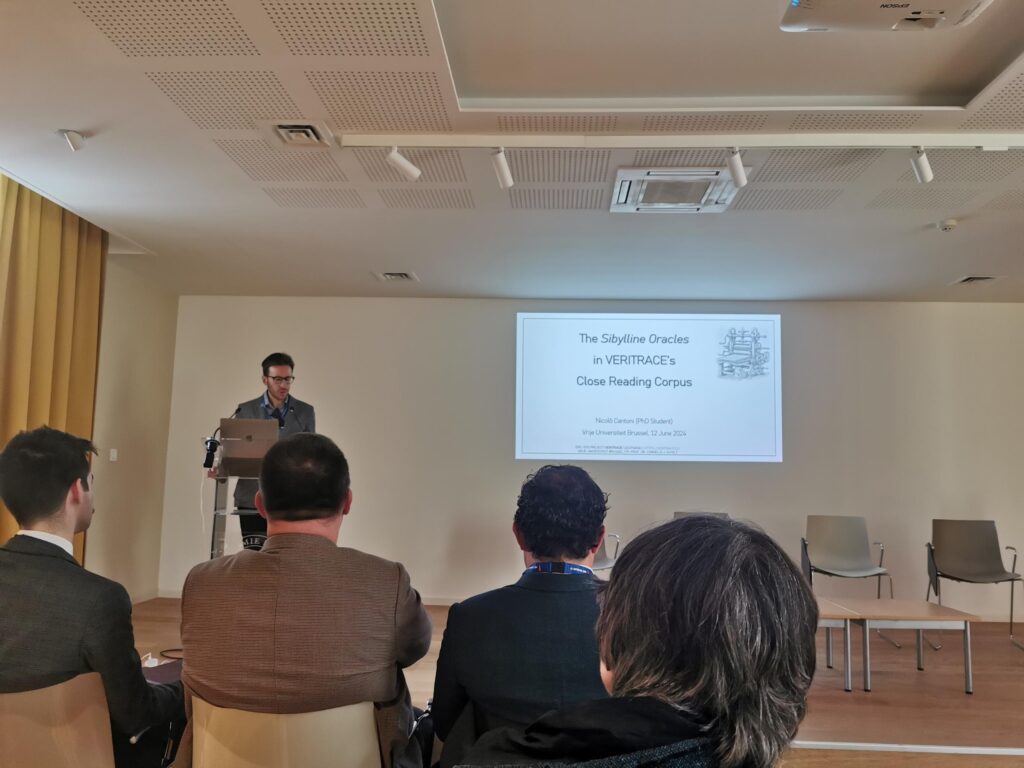


VERITRACE Panel Presentation at the Scientiae Conference (June 2024)
From September 4th to 7th, our VERITRACE team travelled to Barcelona for the 11th European Society for the History of Science (ESHS) Conference. With the historic city’s lively streets as our backdrop, we engaged in thought-provoking discussions. We shared our latest findings on the influence of ancient wisdom on early modern natural philosophy.
The conference theme, Science, Technology, Humanity, and the Earth, invited us all to reflect deeply on our project, which tries to combine Digital and traditional Humanities Scholarship. It reminded us that our work as historians is not merely an academic pursuit but also a way to contribute to the ongoing conversation about humanity’s future. We were privileged to present our work in a panel titled “VERITRACE, or, how to find ‘traces de la verité’ in a sea of ancient wisdom“. The panel, organised and chaired by our PI, Prof. Schilt, aimed to showcase how modern digital tools help uncover historical connections and influences within early modern natural philosophy.
Our presentations took the audience on a journey from the Renaissance rediscovery of ancient texts like the Corpus Hermeticum and the Chaldean Oracles to the unique methodologies VERITRACE employs today. We demonstrated how these texts, once revered as part of a prisca sapientia tradition, continue to reveal new insights into the evolution of scientific thought. Jeff’s exploration of new technologies in historical research and Eszter’s innovative approach to Named Entity Recognition for early modern texts highlighted how traditional scholarship can meet the digital age with remarkable results. Their presentations showcased how we leverage Natural Language Processing (NLP), APIs, and machine learning tools to parse vast volumes of historical material, thus bridging the gap between modern technology and ancient wisdom.
Nicolò discussed the relationship between utopian thought, millenarianism, and the prisca sapientia tradition, with a particular focus on Francis Bacon’s New Atlantis. He explored how Bacon’s work reflects the intertwining of science, philosophy, and religion and how the pursuit of an ancient wisdom tradition shaped the early modern quest for knowledge. This analysis highlighted the intriguing duality of progress and restoration in Bacon’s thought, engaging the audience in a reflection on the multifaceted legacy of early modern science. Demetrios presented a vocabulary-based analysis of the Chaldean Oracles, employing TF-IDF methodology to uncover patterns in Francesco Patrizi’s Latin translation. He highlighted how computational methods can be used to analyse prisca sapientia texts, identifying significant terminologies that reveal the intertextual dialogues between Neoplatonic thought and Renaissance Christian philosophy.
Another highlight was interacting with the audience, which included established scholars and emerging researchers. The questions and discussions that followed our presentations enriched our understanding and offered new perspectives on our work. It was clear that our exploration of how ancient texts influenced early modern natural philosophers struck a chord with many in attendance, sparking a dialogue that extended well beyond the confines of our scheduled panel time.


The VERITRACE Panel in action at the ESHS Conference
We are grateful to the ESHS conference organisers and fellow historians who joined us for our panel. It was an incredible experience to dialogue about the enduring echoes of ancient wisdom in modern times, especially in a vibrant city like Barcelona. We also wish to thank the participants for their insightful questions, which have provided us with new avenues to explore in our future work.
We are excited to continue sharing our journey and contributing to the broader discourse on the history of science and scholarship. We look forward to the next opportunity to connect with our colleagues across Europe and beyond. Stay tuned for more updates, including our first VERITRACE publications and other exciting developments we’ve been working on!