
Nicolò Cantoni
In November we made our first trip and group presentation as a VERITRACE team. Four members of the team – Cornelis, Eszter, Demetrios, and myself (Jeff could not join us from Berlin) – traveled to Ghent for the Logic, History and Philosophy of Science (LHPS) Research Day, a joint event between Ghent University and the Centre for Logic and Philosophy of Science of the VUB. At the evocative venue of KANTL (a Dutch acronym for the “Royal Academy for Dutch Language and Literature”), we had the pleasure of presenting the purposes of our project to an audience of brilliant researchers, unfamiliar with the topics covered by VERITRACE.
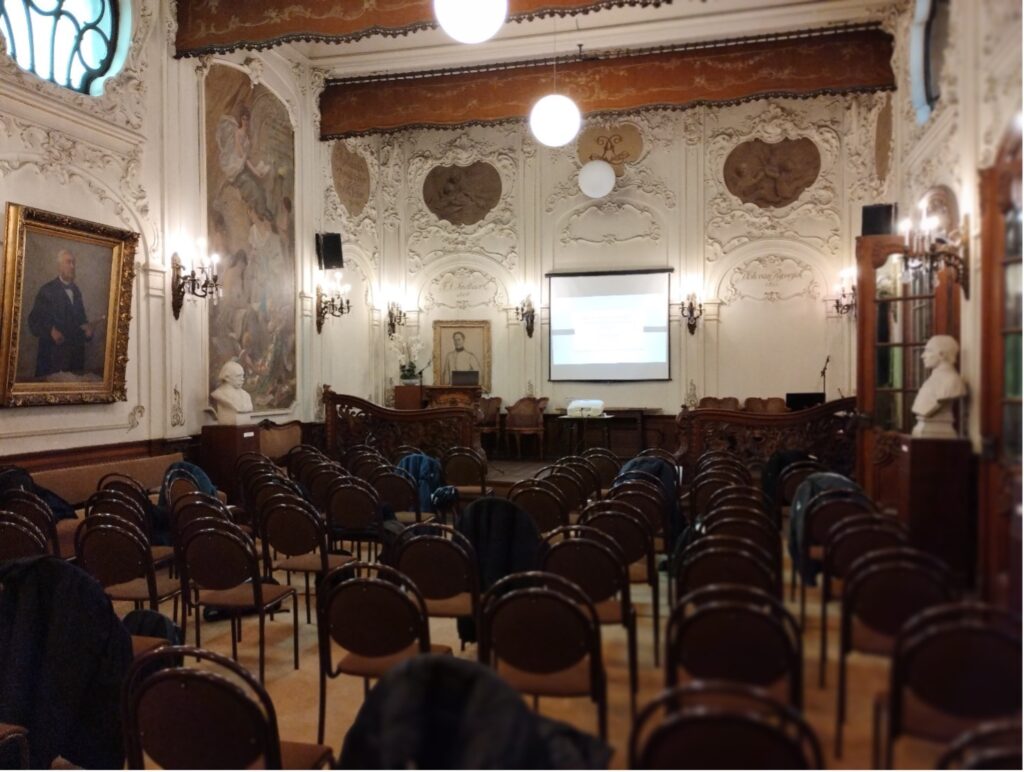
We were allotted a 45-minute slot, a generous time that allowed us to delve into different aspects of the research and left ample time for questions from the audience. The honour of getting the ball rolling could only fall to our PI, Prof. Schilt. In his introduction, entitled “The reappropriation of ancient wisdom in early modern natural philosophy,” he outlined an overview of the state of the art and raison d’être of VERITRACE. The unveiling of the corpus of texts we will examine, and the related digital research methodologies we will use, was propaedeutic to the description of the project’s overall goals and served as a preview to the different lines of research discussed by the other members of the team.
In my presentation, “The rediscovery of the prisca sapientia in the Italian Renaissance,” I outlined the historical and geographical coordinates at the core of VERITRACE and my PhD project. I dwelt on the reception of the pagan and Jewish ancient wisdom in fifteenth-century Italy, highlighting the paradoxical implications, novelties and conflicts in the Christian Catholic world.
It was then Demetrios’ turn, who with his talk “Tracing stoicism in prisca sapientia and early modern science,” sketched the outlines and trajectory of his PhD research. After introducing the key features of Stoicism, he revealed some of the crucial questions that will inspire his meticulous exploration of the links between prisca sapientia, Platonism, and Stoicism.
Finally, Eszter talked about the research goals and methodology in her presentation “Ancient wisdom in France – New perspectives”. Pushing beyond D. P. Walker’s seminal (but now dated) studies on the prisca sapientia in France, she has revealed her intention to explore the influence of ancient wisdom on the works of early modern women philosophers, and other often neglected French philosophers, such as Jean Le Clerc. She also announced her plan to map the terminologies related to the prisca sapientia in early modern thought in order to create a multilingual vocabulary.
Of course we are only at the preliminary stages of our ambitious journey. So we took the LHPS Research Day in Ghent as a first valuable opportunity to disseminate our mission statement. We were welcomed in a refined venue with a vibrant yet relaxed atmosphere, and we came back to Brussels reinvigorated and full of enthusiasm for the exciting work ahead in the coming months.